| Religion and politics | ||
| Perhaps it was Easter which triggered something in what’s left of Trump’s brain - that decision to 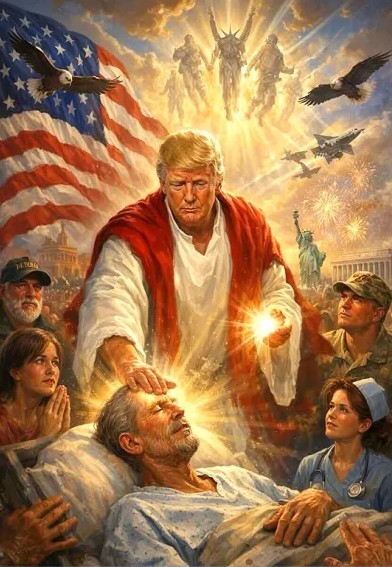 portray himself as
Donald J Christ bringing Epstein back to life. The
AI generated image was accompanied by criticism of
the Pope as being weak on crime, very poor at
foreign policy and only elected to papal office
because Trump was president of the USA. This
caused even more damage to Trump's standing both
amongst Catholics and Protestants. portray himself as
Donald J Christ bringing Epstein back to life. The
AI generated image was accompanied by criticism of
the Pope as being weak on crime, very poor at
foreign policy and only elected to papal office
because Trump was president of the USA. This
caused even more damage to Trump's standing both
amongst Catholics and Protestants. The rest of us looked up ‘God complex’ and found it to be a remarkably accurate description of the man with his finger hovering over the nuclear button – an extreme narcissist. Vance joined in saying that the Pope should stick to morality and should consider his words very carefully when pronouncing on theological questions! This from a recent convert to Catholicism, one who doesn’t understand the parable of the Good Samaritan. He is also part of a government which has an extreme form of Christianity at its centre. So much so that we have large groups of ministers in the Oval office laying hands on and praying for Donald Trump – so far, it seems, ineffectively. Maybe they are in fact praying to him? At a time when three of the worlds leading religions are engaged in a no-holds barred war in the Middle East, when Putin has the blessing of the Russian Orthodox Church for his war against Ukraine and the Hindus in India are persecuting the remaining Muslims, I am glad not to be part of any religion. Among the many virtues of secularism is that I and my fellow non-believers don’t hate anybody for worshipping the wrong god or have to protect a ‘Holy Book’. We don’t regard our adversaries as “wicked souls” who should be delivered into “eternal damnation” (Pete Hegseth). And neither do we refer to passages of ancient texts to legitimise the subjugation of women or the persecution of gays. We can eat as much bacon as we like and drink good burgundy to our hearts’ content So then it feels like an appropriate moment to celebrate my disowning of the whole thing many years ago. And non-belief is looking very much like the way to go granted religion’s contribution to war and to inter-communal tensions in the UK and elsewhere. I recognise, of course, that being part of a majority is not confirmation that I’m now in the right. But Europe is these days largely secular. Even in an America, whose evangelicals are increasingly raucous, the proportion of people with no religious affiliation has risen from 5% in 1990 to 33% now. And surely religion’s central role in the present situation – and Pete Hegseth self-appointed role as Christ’s anointed ambassador for war on earth - will turn even more people against it. For those who have been deeply involved in religion for some time, it is difficult to accept you were wrong. There is the loss of the belief in eternal life and, more immediately, a loss of community. Religions encourage you to be part of a community and leaving it is not easy. I speak from experience. Although there were thought to be signs that young people were turning to Christianity in large numbers, the great revival indicated by a recent Bible Society poll is now admitted to be a figment of the Church’s imagination. Their results were simply wrong. Instead, amongst the young in the West, religion has largely become an irrelevance and so they are unlikely later on to get involved in it. Which means that we non-believers will have the responsibility for leading society into a bright new peaceful future. But isn’t that a little optimistic? The last two world wars were hardly motivated by religion. Neither were American engagements in the 20th century. They were motivated by a wish to stop the progress of communism or, in the case of Iraq 'justified' by the lie that Saddam Hussein had weapons of mass destruction. So then, even if we could abolish religion and the hatred it engenders, it would only remove one of very many motivations to go to war. We have a long way to go before we reach a peaceful Utopia. Obviously a smooth-running and orderly society is for the benefit of us all. However, in our mainly secular age, we see instead an increase in County lines for supplying drugs, ‘low-level’ crime such as robbing people of their mobile phones as they walk along the street and shop-lifting. In full sight of cameras, people now blatantly clear the shelves in shops, with no action being taken by the police. There are dozens of online sites which offer shoplifting tips, as if about gardening or cooking. This has followed on from the disappearance of the old disincentive to this sort of behaviour - the shame of being found out. The benefits-cheat, pictured zip-lining on a Mexican holiday while drawing disability allowance, pleaded that it was just one day of good health. Nearly two thirds of under-24s tell pollsters that shop-lifting is acceptable because of the cost of living. A form of applied Socialism? The patron saint of shamelessness is the former Duchess Sarah Ferguson: one of her many disgraces produced the immortal line: “I was in a hurting place back then.” Online there is page after page of ways to avoid feeling shame. It is as if shame is a mental illness - one which can perhaps give rise to a claim for benefits? But why do we have shame and guilt at all? Well, the biologist Robert Trivers (who died recently) tells us that, from an evolutionary perspective, it serves to promote altruistic behaviour. It’s fairly easy to see why we would act altruistically towards members of our family. In early times, the family was our immediate group, needing to work together for the benefit of all. Even on a larger, tribal, scale, one person’s success depended largely on the success of the tribe, who were mostly members of an extended family. But in today’s urban societies, the family connection is largely absent. So why do we help friends or even people who are just acquaintances and so share no genes with us? Trivers explained it in terms of natural selection. He argued that altruism depended on the possibility of reciprocity. As long as helping a non-relative is not too costly, and there is sufficient probability that the favour would one day be returned, genes coding for altruistic dispositions will spread. The sociability promoted increases success for the community at large as well as for the individuals involved. But Trivers tells us that, for reciprocal altruism to work well, it must be possible to notice and punish cheaters. His model explains why altruism co-evolves with a host of moral emotions, such as a sense of fairness, righteous outrage, gratitude, guilt, contempt for cheaters and an appetite for retribution. These function as enforcement mechanisms to prevent altruistic conduct from being undermined by free-riders. Belief in an all-seeing god amplified those enforcement mechanisms. Now although god is less of a presence in today’s society, all the emotions we have evolved still exist. And we see that in the space left by the previous version of Christianity, populist politicians have now alighted on an identitarian, nationalistic, version of Christianity. They have adopted it in order to misuse those same emotions to try to gain power. Their description of ours as a ‘Christian nation’ is used as indirect support for racism. They encourage us to see all immigrants as ‘unfairly’ taking advantage of our benefits system and do not admit a moral case for helping the week and disadvantaged. But in their strange new religious world neither do they think that they have to obey any particular moral code in their own lives – for instance in not giving their relatives and mates contracts in dubious circumstances or avoiding taxes. With the Pope going in one direction and politicians in another, we have contrasting mutations of the religious meme. Which, if either, will win? 16 April 2026 Paul Buckingham |
||
|
|